Halls of the Forgotten Web
A Tribute to the Wolfenstein 3D Fan Sites That Built a Community
Before YouTube tutorials, before Steam Workshop, before Discord servers, there were the fan sites. Lovingly assembled in Notepad or Frontpage, uploaded over 56k modems, adorned with VSWAP-ripped textures and MIDI files that played the moment you landed on the page. They were the beating heart of the Wolfenstein 3D community.
If you were part of the Wolfenstein 3D scene in the late 1990s or early 2000s, you know exactly what we're talking about. A sprawling, chaotic, beautiful constellation of personal homepages — hosted on Geocities, Angelfire, Tripod, and whatever free webspace your ISP threw in — all devoted to a DOS game that id Software had shipped in 1992 and the world had largely moved on from. The Wolf3D community had not moved on. It was just getting started.
These pages were the primary infrastructure of the hobby. No centralised storefront, no algorithm-driven discovery. You found things through link pages, webring hops, and word of mouth on the message boards. Someone would mention a new add-on set on the forums, you'd follow three links to land on a site with a stone-grey background and a looping Wondering About My Loved One MIDI, and there it would be: a ZIP file, a screenshot, maybe a hand-typed readme. The whole beautiful mess of it.
The Template
Nearly every Wolf3D fan site followed the same loose template, and nobody apologised for it. You had your enemy sprites page — Hans Grosse, the Officers, the SS Guards, all lovingly catalogued with stats. You had your treasure rundown, your floor and ceiling colour tables, your cheat codes. You had a screenshots gallery. You had a links page that linked to every other Wolf3D site you'd ever visited, which linked right back to you.
Backgrounds were almost always textured — ported straight from the VSWAP, or edited slightly to tile more cleanly. Stone grey, blue brick, brown dungeon wall. The colour scheme was dark, the text was usually white or bright yellow, and if you were really putting in effort, you'd have a custom banner image up top with the site's name rendered in a chunky pixel font, often featuring BJ Blazkowicz or one of the bosses looming in the corner.
And the music. Oh, the music. The page would load — slowly, always slowly — and before the images had even finished rendering, the MIDI would kick in. Get Psyched! or the title screen theme, looping endlessly. You learned very quickly where the mute button was on your speakers, especially if you were browsing at midnight while the rest of the house slept.
The Sites
There were dozens of them — probably well over a hundred at the scene's peak — and every one felt like a distinct place. Here are some of the ones that mattered, and some that simply existed, which amounted to the same thing.
The Big Ones
Wolfenstein 3D Dome was the closest thing the community had to a central hub for years. Wolf3D World, built by Nate Smith, was another well-designed fixture — info, downloads, screenshots, hints and tips, all put together with real care. The Wolfenstein 3D Lodge had it all: characters, add-ons, utilities, links, cheats. Wolfenstein Domain kept getting revamped and moving to new URLs, which was its own kind of tradition.
The Ultimate Wolfenstein 3D Page lived up to its ambitious name better than most, stocking cheats, downloads, and editors. Wolf3D Vault — first Barry's, then Jack Ryerson's — was the definitive add-on repository for a long stretch, piling up levels and projects section after projects section. Wolfenstein 3D Archive covered both PC and Mac versions with info, codes, images, links, and levels — a genuinely comprehensive effort.
The Personal Pages
The personal pages were the soul of the web. Spifferaneous' Wolfenstein Page came with news, reviews, links, and the world's first Wolfenstein encyclopaedia — a claim so specific it had to be true. John Bucksnort's Wolf 3D Page eventually became a railroad site, which is one of the more poignant exits a Wolf3D page ever made. Shawn Moseley's Wolf 3D Page was a genuinely good all-rounder: cheats, editors, the full story of Wolfenstein and Spear, and a lot of downloads.
Howling Wolfenstein 3D — previously JLB's Wolfenstein 3D Place — was run by John Burnett III and had an awards page, which meant other sites were submitting their work for evaluation. OleMann's Wolfenstein 3-D Website got revamped and was well presented. King84's Wolfenstein 3D Homepage had cheats, enemies, downloads, and links — the complete package. Greg's Wolfenstein 3D Page had info on the game and his own add-on. Sam's Wolfenstein Page, by Sam Chiang, had links, add-ons, and info. Little Snabes Little Wolfsite had info, downloads, links, and much more — whatever more meant, you went and found out yourself.
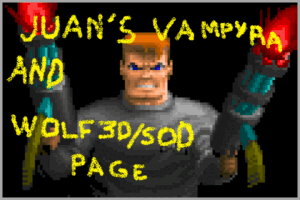
Jagdpanther's Wolfenstein Site — later rebranded as Yellowjacket's Tavern — had good pics from Projekt Wolf and even a Civilization II section tucked in, because the 2000s were a time when a man could have whatever he wanted on his website. Juan's Vampyra and Wolf3D/SOD Page was a curiosity: a TC in progress alongside the usual Wolf3D links and downloads. The Wolf3D Mansion by Kenny eventually put up a companion Spear of Destiny page, and then alas, one day, all that remained was a closing message.
The Francophone Corner
Not everything was in English. Fortress Wolfenstein was a huge French-language site run by Lord W — news, downloads, cheat codes, pics, and as he put it himself: Tout sur la série Wolfenstein et ses auteurs en Français. Everything about the Wolfenstein series and its authors, in French. The banner alone was a mood. The Wolf's Stone, by Jean Morel, had links and project news. There was also a Polish-language scene — Wolfenstein 3D - In Polish and the enormous Wolfenstein Wiecznie Zywy by Kuki — plus an Italian contingent via TexZK's Web, available in both Italian and English.
The TC and Mod Pages
Many sites existed specifically to promote a total conversion in progress. Progress was often slow, previews were tantalising, and the promised release date had a way of slipping. Projekt: Vertilgung by Zach Higgins had info and lots of pics from his TC. Operation: God Hand was Spiritblade's upcoming set. Operation: Panzerschiff included Ben Blaufarb's latest work. Trench Warfare by Josh was full of pics from the upcoming TC of the same name. Alien Software Website teased multiple upcoming TCs. The Luftwaffer II Headquarters by Erick Frost was dedicated to that particular addon. Counter-Wolf, run by Ryan King, tracked his own project. WolfenAliens by Wes Desjardins collected all his TC news and downloads in one place.
Monster Bash 3D was Ryan Steinbruner's project. Challenger 3D by John Lewandowski promised a trial version soon. Black GC Site — Hair Machine's place — had info and screenshots on the upcoming TC Super Blitzkrieg. Alexandre Brosseau's Wolf3D Site covered his TC, The Luftwaffe. The cycle of announcement, screenshots, long silence, eventual release (or not) — that was the rhythm of the scene.
The Source Code Scene
After id released the Wolf3D source code in 1995, a whole sub-community sprang up around modifying it. Brandon's Source Code Help Center had hints, tips, and downloads — everything you needed for editing the source. Wolf3D Black Hole had source code info, add-ons, and links. Wolf3D Realm by Chad Allard ran source code tutorials alongside the usual links and mods. MCS' Coding Tips, part of the AReyeP/MCS site, had lesser-known tutorials that serious coders passed around like secret knowledge. TexZK's Web had a source code section alongside its TC coverage. Source Code Zone Club, founded by David Gebler, was the Yahoo club variant of the same impulse.
The Editors, Utilities, and Tools Pages
Wolfnode was the home of FloEdit and MegaDemo — two tools that serious editors depended on. Brandon's Wolfenstein 3D Utility made it easy to switch between all your Wolf3D add-ons. WolfMenu v1.2 by Andy Nonymous was an older patch swapper for the DOS user who wanted to launch all Wolf3D patches from one place. David Brooks' Wolfenstein 3D Page had patches, Pac-Man level pictures, and a Patch Swapper program. WinWolf3D, hosted by Adam Biser, ran a public test version of WDC (Wolf3D Data Compiler) with most of the capabilities of FloEdit2.
The Reference and FAQ Pages
Halls of Stonehenge by Majik Monkee served as an online manual — cool animated GIFs, lots of info, a genuine reference work. B.J. Rowan's Wolfenstein 3D Bunker had lots of technical info, map design tips, a links section, and some downloads. The Wolfenstein 3D FAQ by Adam Williamson answered the questions that kept coming up on every board and mailing list. Game Revolution and Maarten's Gamorama contributed cheats columns. Hamez's City of Wolfenstein had a search feature called Wolfen Search, which was either ambitious or adorable depending on your perspective.
The Banners
Every site worth its salt had a banner. Not for search engine optimisation — there was no algorithm to game — but as a straightforward signal: this place exists, it has a name, here is a small image you can put on your links page. The banner was a kind of handshake. You linked to someone, you used their banner; they reciprocated. The whole web was held together with these 468×60 pixel agreements.
Banners ran the full aesthetic spectrum. Some were simple text on a dark background, all pixel font and attitude. Others were elaborate sprite composites — BJ Blazkowicz facing off against Hans Grosse, or a boss sprite looming over the site name in jagged gothic lettering. The Wolfenstein 3D Vault banner was a masterpiece of the genre. Fortress Wolfenstein's banner looked like a proper title screen. Juan's Vampyra banner had genuine menace. John's Wolfenstein and Spear of Destiny banner made you want to click immediately.
And then there were the awards. Kenny ran a "Site of the Month" award, which meant people were actually being recognised for the effort they put in. You'd find award badge GIFs on the sidebars of recipient sites, small trophies in the digital trophy cabinet of a Geocities page. It mattered. It was community.
The Infrastructure
The web of links was also held together by more formal structures. The Wolfenstein 3D Webring let you hop from site to site in sequence — previous site, next site, random site, full listing. If you had an afternoon free and a decent connection, you could work your way through a substantial chunk of the community in a single session. The webring banner told you where you were in the chain, and the navigation buttons were often the most-clicked elements on the whole page.
The message boards were equally important. The Wolfenstein 3D Forum, hosted by Skoiler, had lots of sections. Dome/Wolfenstein Forums eventually moved to Games-Guru. WolfenCHAT saved ICQ chat logs and made them available — because the conversations were worth keeping. Sam's Anything Board, hosted by Sam Feichter, covered Wolf3D alongside Mortal Kombat, Grand Theft Auto, Super Mario, and whatever else the regulars felt like discussing. The BWS Software Message Board served as a dedicated space for add-on makers working with the Wolf3D engine.
Yahoo Clubs added another layer — The Ultimate Wolfenstein 3D & Spear of Destiny Group, founded by Jonathan Storey, was one of them. These were the Discord servers of their day: slow, text-only, utterly indispensable.
What Remains
Most of these pages are gone now. Geocities was shut down by Yahoo in 2009. Angelfire and Tripod still technically exist but the sites they hosted are largely dead links. Some were archived by the Wayback Machine; many were not. The banners especially — those small GIFs that were passed hand to hand across a hundred link pages — have mostly disappeared.
What the old Wolf3D web represented, though, hasn't gone anywhere. The spirit of it — one person deciding that this game mattered enough to spend their evenings building a page about it, to package up their add-on and put it online, to learn a bit of source code and write up what they found — that spirit is still very much alive. It just lives in different places now.
But there was something particular about the old web that's hard to reproduce. Every site was its own world. You'd land on a page and not know what you were going to find — a new level set, a bizarre editorial about the game's history, a photo of the webmaster's cat, a broken MIDI player, an award badge from 1999. The randomness was the point. The Wolfenstein 3D community was a place where you could spend hours just following links.
For nostalgic purposes, we have lovingly reproduced the old banners below. If you have one we miss, please send it to us!