Before it was a high-octane shooter, Wolfenstein started as a pioneering stealth game. From the Apple II to modern VR, here is the fully expanded history of the franchise, including the official sequels, the reboots, and the bizarre 90s spin-offs that borrowed its iconic engine.
The Origins: Muse Software
Before the 3D revolution, the series was built on 2D stealth mechanics created by Silas Warner.
Castle Wolfenstein (1981)
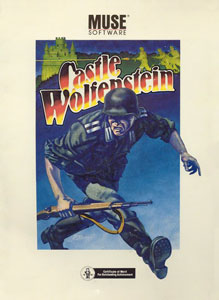
The grandfather of the franchise, released for the Apple II.
-
Gameplay Mechanics: It was a top-down stealth game where the goal was to steal Nazi uniforms to escape undetected. You could hold up guards, pick locks, and search bodies.
-
Tech & Innovation: It featured early procedural generation (rooms changed when you died) and digitized voice synthesis, which was mind-blowing at the time (guards shouting "Achtung!" or "Halt!").
-
Legacy: It directly inspired games like Metal Gear and laid the thematic groundwork for id Software a decade later.
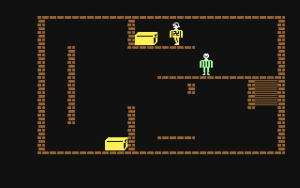
Beyond Castle Wolfenstein (1984)

A direct sequel that maintained the top-down perspective but refined the stealth.
-
The Mission: Your objective was to infiltrate Hitler's secret Berlin bunker, find the bomb, and plant it outside his conference room.
-
New Mechanics: Introduced the ability to drag dead bodies to hide them from patrols, bribe guards with money, and use a "pass" system where guards would demand identification.
-
Combat: Combat was actually discouraged; shooting your weapon would immediately sound the alarm, forcing you to rely almost entirely on sneaking.
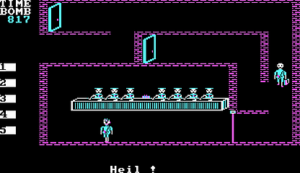
The FPS Revolution: id Software
The era that defined the First-Person Shooter genre using John Carmack's ray-casting engine.
Wolfenstein 3D (1992)
The game that changed everything. Fast, bloody, and revolutionary.
-
The Structure: Released under the Apogee shareware model. The first episode (Escape from Wolfenstein) was free, with five more episodes available for purchase (totaling 60 levels).
-
Gameplay: Blazkowicz starts with a knife and a pistol, upgrading to a machine gun and a chaingun. You battle standard guards, SS, mutant experiments, and finally, Adolf Hitler in a mechanized suit equipped with four chainguns.
-
Impact: It popularized the FPS genre, established the WASD/mouse control scheme standard (eventually), and was notoriously banned in Germany until 2019 due to the depiction of swastikas and Nazi imagery.
Spear of Destiny (1992)
The official prequel to Wolf3D, published by FormGen instead of Apogee.
-
The Setup: B.J. must infiltrate Castle Nuremberg to retrieve the mystical Spear of Destiny from the Nazis.
-
Structure: Instead of separate episodes, it featured one continuous 21-level campaign (18 regular, 3 secret).
-
New Additions: It introduced new bosses, including the Death Knight (a precursor to Doom's Cyberdemon) and the Angel of Death.
-
The Mission Packs (1994): FormGen later developed two retail-only mission packs (Return to Danger and Ultimate Challenge) that featured new textures, sprites, and scenarios, though they were not developed by id Software.
The Spin-Offs & Engine Clones (The 1990s)
Once id Software struck gold, they licensed the Wolf3D engine out. This led to a wave of spiritual successors, clones, and bizarre alternatives.
Blake Stone: Aliens of Gold (1993)
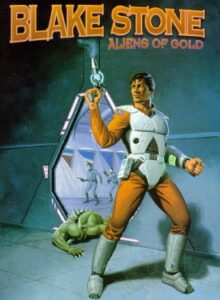
Apogee’s futuristic take on the formula, developed by JAM Productions.
-
The Plot: British agent Blake Stone hunts the mad geneticist Dr. Pyrus Goldfire in the 22nd century.
-
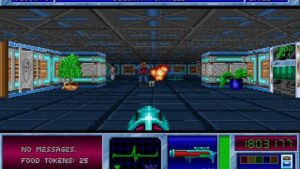
Engine Upgrades: It introduced massive upgrades over Wolf3D, including built-in auto-mapping, textured floors/ceilings, one-way doors, and vending machines where you could buy food with looted tokens.
-
Friendly NPCs: It was one of the first shooters to feature non-hostile NPCs (informants) who would give you ammo, tokens, or radar hints if you didn't shoot them.
Blake Stone: Planet Strike (1994)

A retail-only sequel featuring a single, highly detailed 20-level episode.
-
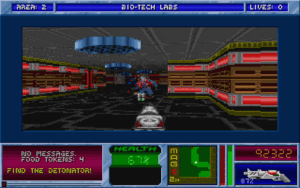
New Mechanics: Introduced the Fission Detonator (used to blow open security cubes) and an anti-plasma cannon.
-
Enemy AI: Enemies were smarter, could cloak themselves to become invisible, and some mutants morphed from statues into monsters when you approached.
Operation Body Count (1994)
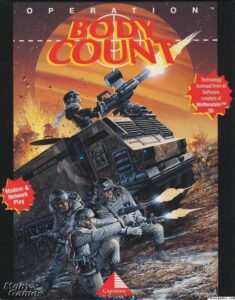
Developed by Capstone Software. Widely considered one of the worst games of the era.
-
The Premise: You play as an elite anti-terrorist taking back the 40-story U.N. building in New York.
-
The Gimmick: You could issue basic commands to AI squadmates. Unfortunately, the AI was so terrible they usually ran straight into enemy fire and died instantly.
-
Design: Suffered from awful hit detection, repetitive environments (lots of gray sewers and office drywall), and boring level design.
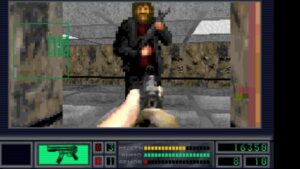
Corridor 7: Alien Invasion (1995)
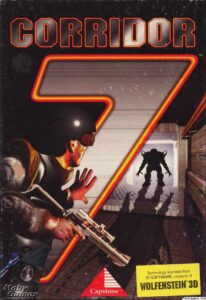
Another Capstone title. Aliens invade the underground Delta Base via a metallic artifact from Mars.
-
Visor Mechanics: The game featured invisible aliens and proximity mines, forcing the player to rely on infrared and night-vision visor modes to survive.
-
Engine Pushes: Included walls that dispensed ammo and health, and it was one of the few Wolf3D engine games to support multiplayer deathmatch.
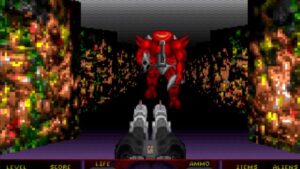
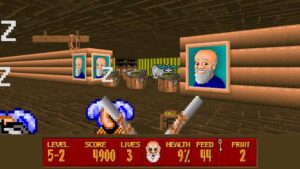
Super 3D Noah's Ark (1993)

The ultimate Christian game clone by Wisdom Tree.
-
The Legend: Rumors claimed id Software gave Wisdom Tree the engine to anger Nintendo (who heavily censored the SNES port of Wolf3D). In reality, Wisdom Tree just bought a standard license.
-
Gameplay: You play as Noah. Instead of shooting Nazis, you use slingshots to fire sleep-inducing cantaloupes and watermelons at angry animals (goats, ostriches, monkeys) to put them to sleep.
-
Hardware Bypass: The SNES cartridge featured a "pass-through" slot on top where you had to plug in an official Nintendo game to bypass the console's lockout chip.
Rise of the Triad (Original Concept)
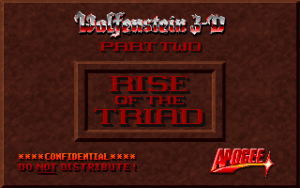
ROTT started as a Wolf3D sequel.
-
The Pitch: Originally designed by Tom Hall as "Wolfenstein 3D Part II". It was supposed to feature purple/green-uniformed guards, Demon Dogs, and Death Monks.
-
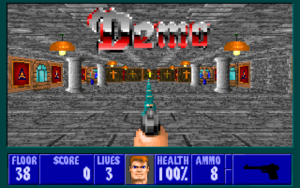
The Pivot: id Software canceled it because it strayed too far from the WW2 theme. Apogee took the ideas, built a heavily modified engine, and released it as the standalone Rise of the Triad (featuring jump pads, extreme gore, and flying mechanics).
The Modern Era: Activision & EA
The franchise's transition into fully modern 3D graphics and multiplayer supremacy.
Return to Castle Wolfenstein (2001)
Developed by Gray Matter Interactive using the Quake III engine (id Tech 3).
-
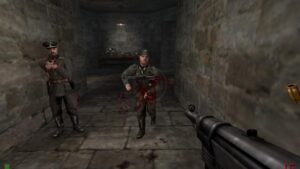
The Campaign: A phenomenal reboot that fully leaned into the occult and weird-science aspects of the Nazis. You fought SS guards alongside mechanically augmented "Lopers," undead knights, and the Venom Gun-wielding supersoldiers in Heinrich Himmler's SS Paranormal Division.
-
Multiplayer: Developed separately by Nerve Software, the multiplayer was a masterpiece. It featured axis vs. allies objective-based warfare with specific classes (Medic, Engineer, Lieutenant, Soldier).
Wolfenstein: Enemy Territory (2003)
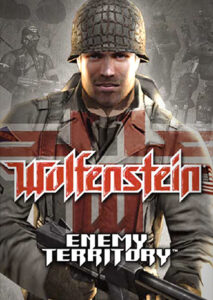
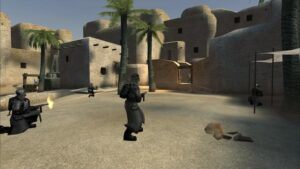
Originally planned as an expansion for RTCW, it was released as a free standalone multiplayer game by Splash Damage.
-
The Legacy: It remains one of the most popular and influential multiplayer shooters of all time. It required tight team coordination to complete objectives like escorting tanks or stealing radar parts.
-
Progression: It introduced a system where players earned XP during a campaign, upgrading their class skills (e.g., Medics throwing health packs faster) as the match progressed.
Wolfenstein RPG (2008)
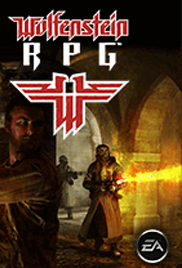
A mobile, turn-based spin-off developed by EA and id Software.
-
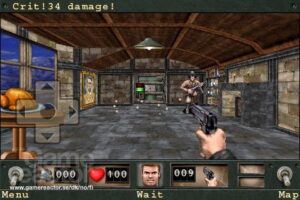
Gameplay: Designed specifically for the cell phones of the era (Java/BREW and early iOS), you navigated grids and fought enemies in turn-based combat, mixing serums to boost your stats.
-
Lore Connection: It featured a boss called the "Harbinger of Doom" (a Nazi-summoned Cyberdemon). After B.J. blows off its arm and leg, the demon swears it will return to haunt his descendants—directly linking the Wolfenstein and Doom timelines.
Wolfenstein (2009)

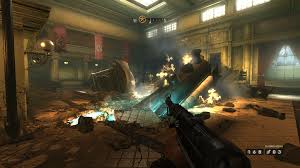
Developed by Raven Software using id Tech 4.
-
The Gimmick: B.J. acquires a medallion that lets him enter a supernatural dimension called "The Veil." This allowed players to slow time, deploy shields, or empower their bullets to shoot through cover.
-
Structure: It featured a semi-open hub world (the fictional city of Isenstadt) where you could take missions from resistance factions and buy weapon upgrades from the Black Market. It underperformed commercially and is largely ignored by current canon.
The MachineGames Era
Bethesda and MachineGames completely reimagined the franchise, combining brutal combat with incredibly deep, character-driven storytelling.
Wolfenstein: The New Order (2014)
A masterpiece of the modern era that successfully revived the franchise.
-
The Setting: Set in an alternate 1960s where the Nazis won WWII using advanced technology. B.J. wakes up from a 14-year coma in a Polish asylum to join the resistance.
-
Mechanics: Blended old-school health/armor pickups with modern mechanics. You could dual-wield almost any weapon (including automatic shotguns and sniper rifles) and lean out of cover.
-
Commanders: Introduced the "Commander" stealth mechanic. If you didn't silently kill Nazi officers first, they would continuously call in reinforcements.
Wolfenstein: The Old Blood (2015)

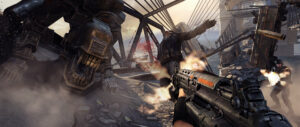
A standalone prequel to The New Order, running on id Tech 5.
-
The Vibe: A loving, B-movie style homage to Return to Castle Wolfenstein. It is split into two halves: infiltrating Castle Wolfenstein, and dealing with an occult excavation in the town of Wulfburg.
-
The Arsenal: Replaced dual-wielding heavy weapons with a trusty, multi-purpose metal pipe used for climbing walls, prying open doors, and brutal melee takedowns. Included an arcade-style "Challenge" mode.
Wolfenstein II: The New Colossus (2017)
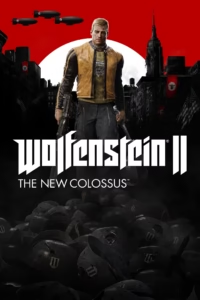
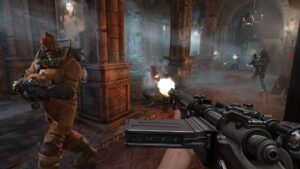
B.J. brings the revolution to a Nazi-occupied America.
-
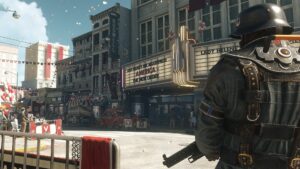
The Story: An incredibly cinematic, violent, and emotional narrative. You visit a nuked Manhattan, a parade in Roswell (New Mexico), and a Nazi base on Venus (where you meet an aging, paranoid Adolf Hitler).
-
Contraptions: Halfway through the game, B.J. gets a new body and can choose a "Contraption": Ram Shackles (tackle through walls), Battle Walkers (extendable mechanical stilts), or the Constrictor Harness (squeeze through tiny pipes).
Wolfenstein: Youngblood (2019)

A co-op focused spin-off co-developed with Arkane Studios.
-
The Premise: You play as B.J.'s twin daughters, Jess and Soph, searching for their missing father in an alternate 1980s Paris.
-
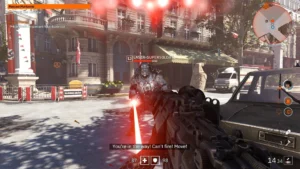
The Shift: Introduced RPG mechanics, including health bars above enemies, level-gating (enemies too high-level would crush you), and specific ammo types required to break specific enemy shields. This severe shift in gameplay heavily divided the fanbase.
Wolfenstein: Cyberpilot (2019)

A VR spin-off released alongside Youngblood.
-
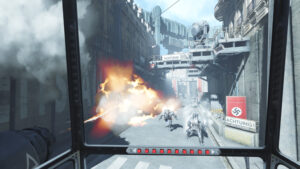
The Gameplay: You play as a French resistance hacker seated in a virtual cockpit. You take control of Nazi war machines (like the fire-breathing Panzerhund and the massive Zitadelle mech) to burn through Paris.
-
Reception: Primarily a tech demo for virtual reality platforms. It was heavily criticized for its clunky controls and extremely short runtime (roughly 2 hours).